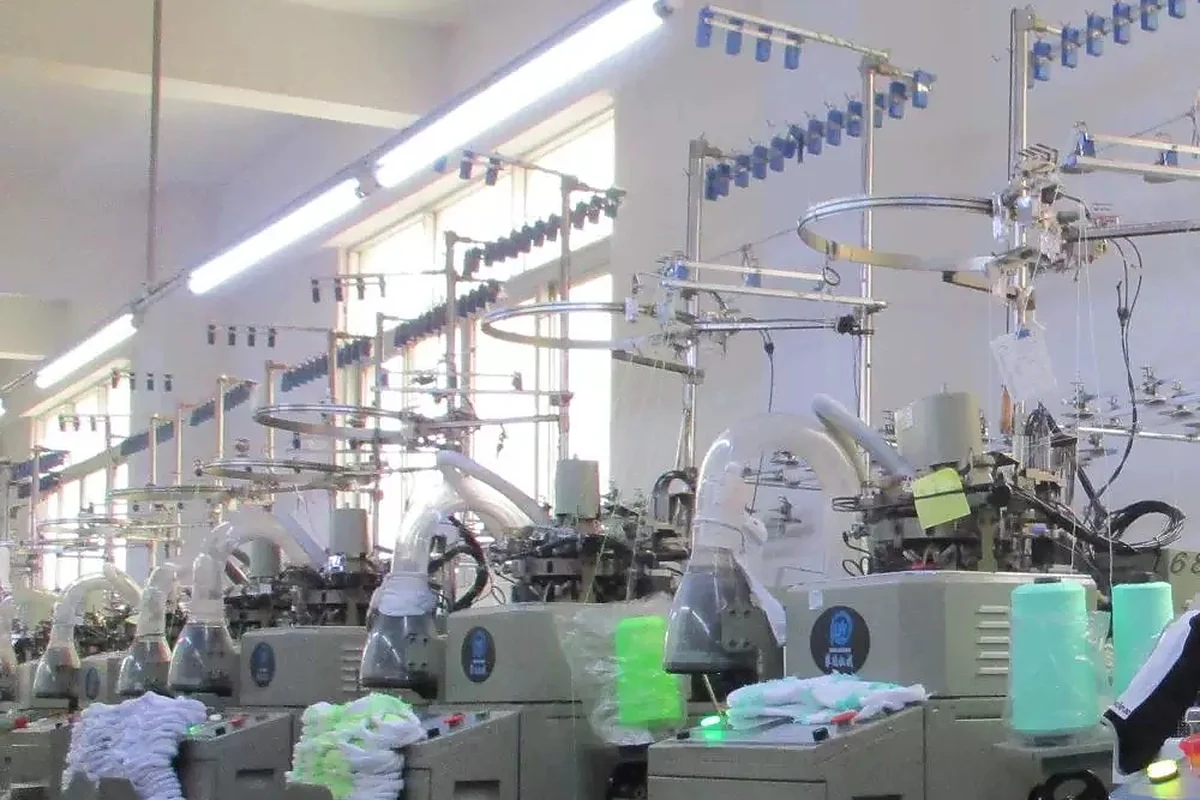
Every football sock looks similar in a photograph. In play, the differences show up within twenty minutes: a cuff that slides down, a grip patch that peels, a seam that rubs the toe. Those are construction decisions, and all of them are made before knitting starts.
Cuff tension is the first decision
A match sock needs a cuff that holds without cutting circulation. We knit a 2x2 rib with a defined elastane percentage and check it on a calf form at production tension rather than trusting the yarn specification.
A cheaper sock saves yarn here and pays for it by halfway through the second half. The visible symptom is a sock that gathers at the ankle, which looks like a sizing error and is actually a cuff problem.
- Elastane content in the cuff, typically 8 to 14 percent
- Rib height and stitch density
- Calf band position on a knee-high tube
Grip that survives the season
Silicone grip is printed in zones, cured, then wash-tested. Dots give the most traction on dry turf; lines and chevrons feel lighter and use less silicone. Specify the zone map, not just grip on the sole, or you will get whatever the printer runs that week.
The failure mode to design against is a thin deposit at the dot edge, which lifts first. The grip page covers deposit weight and the wash test in detail.
Cushioning maps, not cushioning everywhere
Terry under the ball of the foot and the heel absorbs impact where it happens. A full-foot terry sock is warmer and heavier, which suits winter or a hard pitch but not a summer tournament.
Cheap socks either skip terry entirely or use a shallow loop that flattens in three washes. The loop height is a knitting parameter, and it is worth asking what it is rather than whether cushioning exists.
Tube length and the calf band
A knee-high match sock runs 38 to 45 cm from the heel, and the calf band is what keeps it from rotating around the leg. Measure a sock the club already uses rather than quoting a size name, because junior and senior definitions vary by supplier.
Length also affects grip: a longer tube moves differently inside a boot, so if a club is switching from mid-calf to knee-high, the grip layout should be reviewed at the same time.
What to skip
Skip compression claims unless the sock is actually graduated and tested. Skip a heavy terry footbed on a summer tournament sock. Skip printing a full club crest on the sole, where it will be invisible and abraded at once.
Spend the money on the cuff, the grip zone and the size run instead. Those three are what the player feels in the first match.
Size runs for clubs that order once
A club usually orders once, for a season, and gets the size run wrong in the same way every year: too many small sizes and not enough large. The fix is to send a list with player name and size rather than a ratio, and to add ten percent spares in the sizes that actually get replaced.
Junior and senior definitions also vary. A sock labelled junior at one supplier is a youth size at another, so quote the foot length or the tube length rather than the label. That single change prevents most of the returns we see on club orders.
Finally, ask what a late addition costs. Adding ten pairs to an open order before knitting is usually trivial; adding them after knitting means a new setup. Knowing that boundary is more useful than a discount.
The spec sheet to send
Send the tube length, the cuff height, the grip zone map, the cushioning areas, the size split and the colour references. With those six items the proof is close to final on the first pass.
The football socks page carries the standard build; the grip page covers pattern and zone options if the brief is unusual.
One construction detail that gets argued about is the toe closure. A hand-linked toe is flat and comfortable but slower to produce; a rosso-closed toe is faster and leaves a slight ridge. On a match sock worn for ninety minutes the ridge is noticeable, which is why most club orders specify hand-linked and most promotional orders do not.
The cuff is the other place where a small spec change has an outsized effect. Moving from 10 to 14 percent elastane fixes a sliding sock, but it also tightens the fit around the calf, so the size run should be re-checked at the same time rather than assumed.